
Bioreactor Scale-Up Strategy:
Key Concepts and Approaches
Understanding the challenges and strategies for successfully scaling bioreactor processes from laboratory to commercial manufacturing.
Bioreactor scale-up is one of the most critical and challenging aspects of biopharmaceutical process development. Successfully transferring a process from small-scale laboratory reactors to large-scale manufacturing requires careful consideration of the fundamental principles that govern bioreactor performance.
The Scale-Up Challenge
Scale-up is not simply making things bigger. As bioreactor volume increases, the physical and chemical environment changes dramatically. Parameters that don't seem critical at small scale become limiting factors at commercial scale, and vice versa.
Fundamental Scale-Up Parameters
Several key parameters change dramatically during scale-up and must be carefully considered:
Power per volume (P/V) is a common scale-up criterion, but constant P/V is often impractical at large scale due to heat generation and equipment limitations.
Maintaining adequate kLa becomes challenging as scale increases due to reduced surface area-to-volume ratio and gas dispersion limitations.
Mixing time increases dramatically with scale, creating heterogeneity in pH, nutrients, and oxygen distribution.
Scale-Up Approaches
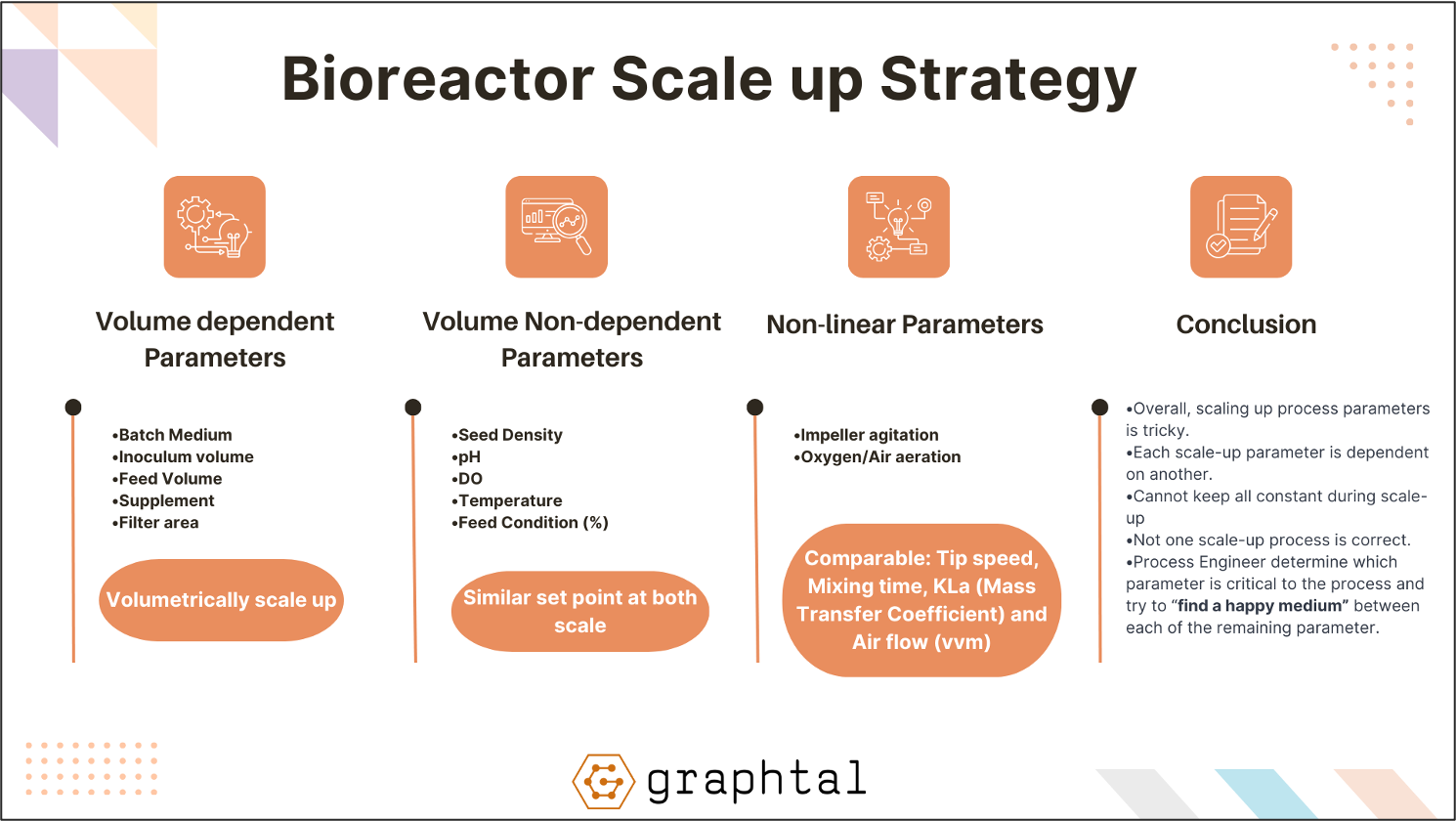
Different scale-up approaches prioritize different process attributes. The choice of approach depends on the specific process and its critical quality attributes.
Constant Power per Volume (P/V)
Maintaining constant power input per unit volume is a traditional scale-up approach that attempts to keep mixing and shear conditions similar. However, this approach often fails at large scale due to:
- Excessive power requirements that exceed equipment capabilities
- Increased heat generation that cannot be removed efficiently
- High shear rates that may damage cells or affect product quality
Constant Tip Speed
Maintaining constant impeller tip speed helps control shear conditions, which can be important for shear-sensitive cells or products. However, this approach often results in:
- Longer mixing times at commercial scale
- Inadequate oxygen transfer rates
- Poor homogeneity leading to process variability
Constant Oxygen Transfer Coefficient (kLa)
Maintaining constant kLa ensures adequate oxygen supply to cells, which is often the most critical parameter for aerobic processes. This approach requires:
- Careful sparger design and gas flow optimization
- Pressure adjustments to increase oxygen solubility
- Compromise in mixing or shear conditions
Constant Mixing Time
Maintaining constant mixing time ensures homogeneous conditions throughout the vessel. This approach is extremely challenging at large scale and typically requires:
- Very high power inputs that may be impractical
- Multiple impellers with careful spacing and sizing
- Significant engineering challenges in large vessels
Practical Scale-Up Strategy
In practice, successful scale-up typically involves balancing multiple criteria rather than strictly following one approach. A pragmatic strategy includes:
Identify which process attributes are most critical for product quality and process robustness.
Design scale-down models that represent the anticipated scale-up limitations before attempting full-scale runs.
Scale up in stages, learning from each scale increase rather than jumping directly to commercial scale.
Implement robust monitoring to detect scale-related issues early and enable process adjustments.
Build flexibility into the scale-up process to accommodate unexpected challenges and alternative approaches.
Thoroughly document scale-up decisions, assumptions, and outcomes to support regulatory submissions and future scale-ups.
Common Scale-Up Pitfalls
Being aware of common mistakes can help avoid costly scale-up failures:
- Ignoring equipment constraints: Assuming that laboratory-scale performance can be replicated with commercial equipment
- Overlooking shear effects: Failing to account for different shear environments on cell viability and product quality
- Inadequate mixing consideration: Not planning for longer mixing times and their impact on process homogeneity
- Poor scale-down model design: Creating scale-down models that don't represent the actual scale-up challenges
- Lack of pilot-scale data: Skipping intermediate scale steps and jumping directly to commercial scale
Final Perspective
Bioreactor scale-up is a complex engineering challenge that requires balancing multiple, often competing, process requirements. Success comes from understanding the fundamental scale-up principles, defining clear priorities, and taking an iterative approach that learns from each stage of the scale-up process.
By acknowledging the inherent challenges and planning accordingly, process engineers can successfully scale bioreactor processes while maintaining product quality and process robustness.


Tell Us About Your Project
Our team of experienced professionals at Graphtal is ready to transform your project from idea to
reality, ensuring alignment with your organisation goals through advanced data analytics and
predictive modelling.
Let's simplify your work